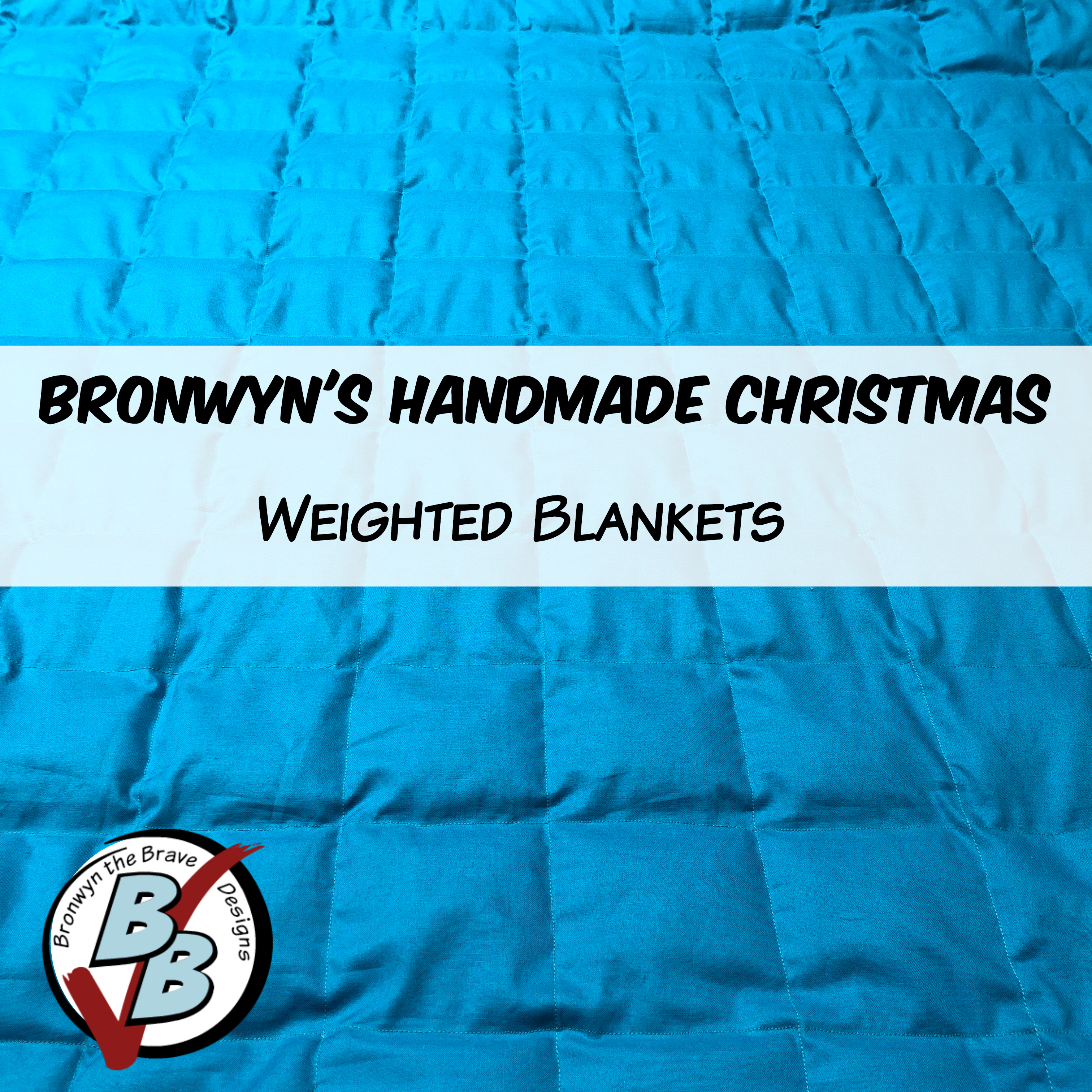
This month’s handmade gift idea is weighted blankets. Have you heard about these? If you haven’t, imagine a blanket made with a couple hundred bean bags sewn together. It’s not quite the same, but it sort of looks like it.
So why would someone want a weighted blanket? They are said to be therapeutic for adults and children with autism, ADHD, anxiety, insomnia, restless leg syndrome, and other sensory disorders. A friend with restless leg syndrome swears by her blanket and even travels with it when she can. Hers weighs 16 pounds. It doesn’t feel like 16 pounds when the weight is distributed over your entire body, though. (I’ve traveled with her and have carried her blanket in a tote bag through the hotel. Trust me—it’s 16 pounds.)
A few months ago, a different friend asked me if I’d ever made one of these blankets. I hadn’t, but it didn’t seem too hard. She wanted this for her daughter who was a freshman in college and dealing with a lot of anxiety at the end of the school year. I was more than glad to help.
After some discussion, we decided that while a soft minky fabric might be comforting, it might be too warm. We settled on some Robert Kaufman Kona Cotton quilting fabric in two colors—Oasis (a gorgeous teal) and Graphite (a medium gray). I bought two yards of each on Amazon (about $6/yard).
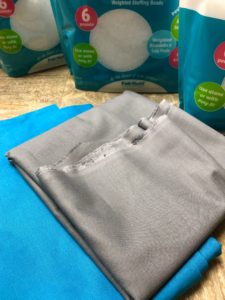
How much weight? A rule of thumb for how much weight to add is to multiply the individual’s weight by 10% and add 1-2 pounds. My friend’s daughter weighs around 125-130, so we went with 14 pounds. I have a small kitchen scale that weighs to the tenth of a gram, so I converted 14 pounds to 6350 grams. Poly-Fil Poly-Pellets come in various packages, but the best deal I found was on 6-pound bags at Joann.com with a coupon. I bought 18 pounds and added a ball of cotton yarn to bump me up to free shipping. (Be sure to buy the hard plastic pellets like the ones inside Beanie Babies, not the Styrofoam beads for bean bag chairs.)
I didn’t bother trimming off the selvedges, but I did even up the cut ends. With right sides together, I sewed the two lengths of fabric on three sides, using a ½″ seam allowance. I then turned it right-side out and pressed it.
How many squares? To make things easier on myself, I made the squares the same width as my quilting ruler—3.5”. I divided the width and length (each) by 3.5 to determine the number of pouches. This gave me 12 columns by 20 rows—a total of 240 squares. Doing the math—6350 grams divided by 240 pouches—that’s about 26.5 grams of pellets per square.
I couldn’t find my marking pen, so I used a sliver of soap to draw my lines. Some of the lines got smudged away as I handled the project, so I did have to re-draw them occasionally. The soap worked in a pinch, though.
Next, I sewed the long columns. This made twelve 6-foot-long tubes, essentially. I weighed out 26.5 grams per tube and shook them to the bottom. (See Tip #2 below.) This was trickier than I expected because the pellets are imperfect with little burrs that catch on the fabric. Once all twelve columns were filled for a row, I placed a row of pins to keep the pellets from sneaking into my seam line and sewed across the width. Twelve more pouches…sew across. After a few rows, I didn’t worry so much about getting every single pellet in its proper square.
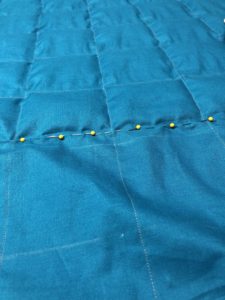
I continued weighing, filling, pinning, and sewing until I got to the final row. I pinned the last row as usual. I tucked the raw edges under and pinned again. I sewed straight across the end.
Tip #1: Set up your sewing machine on a long table so you can spread the blanket out while you sew. I normally use my sewing machine on an old computer desk. After sewing a few rows, the blanket started to get heavy and unwieldy. When I moved everything to a longer table, the sewing sped up considerably.
Tip #2: Fill the upper portion of the columns near the openings and wait to shake the pellets down all the columns together. You’ll be able to tell which column you’re on, and you won’t accidentally miss one or fill one twice.
Bonus Tip: Sewing this blanket can be a surprisingly great workout! My weighing station was on my ironing board, but I was filling and pinning the blanket on the floor. That means I did roughly 250 squats over the course of 24 hours! Add to that, schlepping a heavier and heavier blanket back and forth. I don’t necessarily recommend this workout, but it gave me a great story.
This project costs quite a bit more than my typical Handmade Christmas ideas, about $66 total per blanket. (Shop around and/or wait for good coupons.) If you plan to make several, you might get a better bulk discount on the pellets. This is obviously a special gift you’d make for someone who could really benefit from it, not one to give to all your neighbors and cousins and fringe friends. But this could be the best gift ever for a very lucky person in your life.
Weighted Blanket
Finished Measurements: Approximately 43” x 71”
Materials
Cotton quilting fabric in 2 colors—44-45” wide, 2 yards of each
Poly-Fil Poly-Pellets—about 10% of body weight plus 1-2 pounds
Kitchen scale
Marking pen, quilting ruler, scissors, pins
Sewing thread—2 spools
Paper cups for weighing and pouring pellets into blanket
Instructions
Press fabric. If necessary, trim fabric to square up the ends. Place right sides together.
Using 1/2” seam allowance, sew together along one short and two long edges.
Turn right-side out and press.
Mark lengthwise lines for columns. Sew along these lines.
Mark perpendicular lines for rows, but do not sew yet.
Weigh Poly-Pellets for each square. (See above for calculations.) Pour pellets into each column. Once all columns have been filled, lift blanket and shake pellets to bottom. Pin and sew across row. The squares will not be firmly filled, so don’t worry if they look droopy.
Continue filling one row at a time until all squares have been filled. Pin last row to keep pellets from escaping. Turn both edges to the inside and sew across top of blanket, close to the edge.
Trim any remaining threads and wash blanket to remove pen marks.